

A logo represents a business, organization, team, or brand, so even a small stitching problem can affect how professional it looks. When a logo is blurry, poorly digitized, incorrectly sized, or difficult to stitch, the problem is usually not with the original idea. Instead, the embroidery file may need to be corrected. 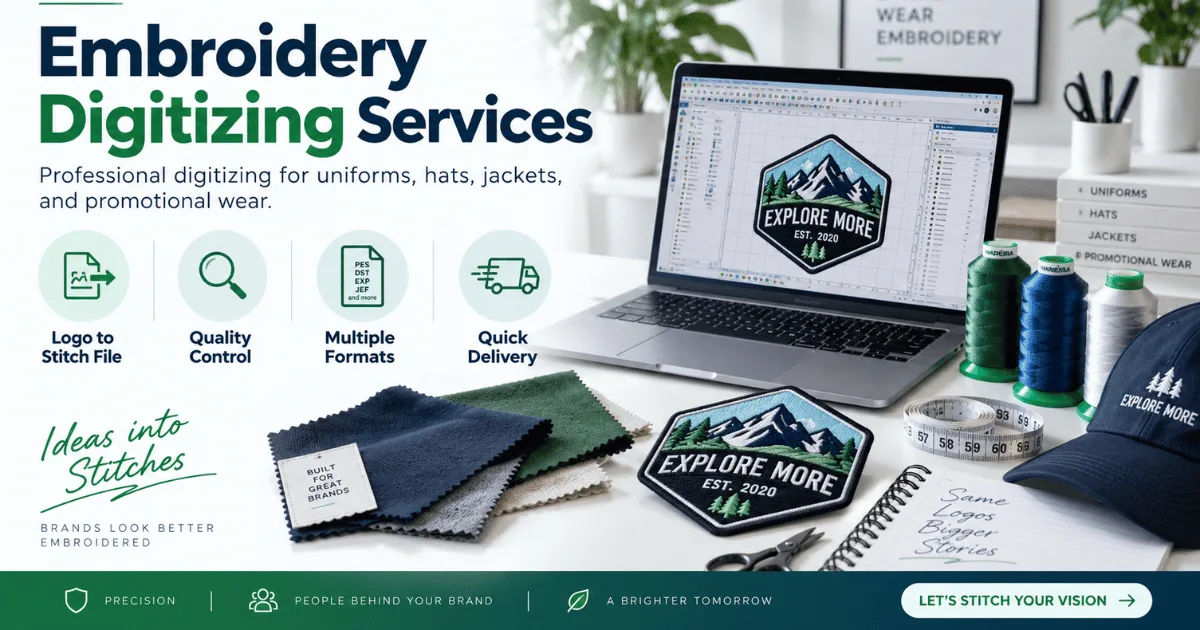 This is where professional embroidery digitizing services can make a major difference. Skilled digitizers can examine an existing logo, identify technical problems, and adjust the embroidery file so the design produces cleaner and more accurate stitches.
Embroidery is very different from printing. A printed logo can contain extremely fine details, smooth gradients, tiny text, and thin lines. Embroidery machines, however, work with stitches, thread, fabric, density, underlay, and machine movements. A logo that looks perfect on a computer screen may not look the same after it is stitched.
For this reason, fixing an embroidery logo requires more than simply changing its size or saving it in another file format. The design may need to be professionally rebuilt or edited to work correctly with embroidery equipment. Understanding what can be fixed helps businesses make better decisions before ordering large quantities of embroidered products.
What Does It Mean to Fix an Embroidery Logo?
Fixing an embroidery logo means identifying and correcting problems that prevent the design from stitching properly or looking professional.
The correction may involve changing stitch types, adjusting stitch density, repairing small gaps, modifying lettering, improving outlines, or changing the sequence in which different elements are embroidered.
Sometimes the original embroidery file is available and can be edited. In other situations, the file may be damaged, poorly created, or unavailable. In that case, the design may need to be digitized again from the original artwork.
The goal is not simply to make the digital image look attractive. The goal is to create an embroidery file that produces a clean physical result on the chosen material.
Why Logos Often Need Embroidery Corrections
A logo designed for a website or business card is normally created for visual display. It may contain details that are too small or complicated for embroidery.
For example, a logo might contain a thin border surrounding small lettering. On a screen, the border may appear sharp. During embroidery, however, the border could become distorted because thread has physical thickness.
Similarly, small letters can become difficult to read when stitched. If the digitizer uses excessive density, the fabric may become stiff and the lettering may lose its shape.
These issues are why professional embroidery digitizing services evaluate the design according to embroidery requirements rather than simply copying the appearance of the original artwork.
Common Logo Problems That Can Be Fixed
There are many problems that a skilled digitizer can correct. Some are simple adjustments, while others require significant redesign of the embroidery file.
Poor Stitch Density
Stitch density refers to how closely stitches are placed together.
Too many stitches can cause thread buildup, puckering, stiffness, and poor detail. Too few stitches can make the logo look weak, incomplete, or uneven.
A professional digitizer can adjust the density according to the fabric, thread, design size, and stitch type.
Uneven Outlines
Outlines are often important parts of logos. They separate colors and help define shapes.
If an outline is uneven or contains unnecessary jumps, the final embroidery can look messy. Adjusting the outline can improve both appearance and production efficiency.
Small or Unreadable Text
Text is one of the most challenging parts of embroidered logos.
Very small lettering may not translate well into stitches. Individual characters can become crowded, distorted, or impossible to read.
An experienced digitizer may need to simplify the lettering, increase its size, change the stitch direction, or use a suitable embroidery font.
Excessive Thread Jumps
Thread jumps occur when the machine moves from one section of a design to another without stitching between the two points.
Too many unnecessary jumps can increase production time and leave unwanted threads on the back or front of the garment.
A properly edited file can reduce unnecessary movements and create a cleaner embroidery result.
Incorrect Stitch Direction
Stitch direction affects how light reflects from embroidered thread.
If all areas use the same direction when they should not, the logo may look flat. Changing stitch angles can create contrast and make shapes easier to recognize.
Professional embroidery digitizing services can strategically change stitch directions to improve the visual appearance of different areas.
Can a Poor-Quality Logo Be Repaired?
In many cases, yes. However, the level of repair depends on the condition of the existing file.
If the file contains editable embroidery information, a digitizer may be able to modify the existing stitches.
If the file is badly digitized, simply editing individual stitches may not be enough. Re-digitizing the design from the original artwork can produce a much better result.
Re-digitizing essentially means creating a new embroidery file based on the logo while applying proper embroidery techniques from the beginning.
This approach can be especially useful when the original file contains incorrect densities, poor sequencing, excessive jumps, or unsuitable stitch types.
What File Types Can Be Fixed?
Embroidery machines use different file formats. Common formats include DST, PES, JEF, EXP, VP3, and others.
A logo may be available in one format but need to be converted into another format for a particular embroidery machine.
However, simply converting a file does not automatically improve its quality.
For example, changing a poorly digitized PES file into a DST file does not fix incorrect stitch density or bad sequencing. The underlying embroidery instructions remain problematic.
A qualified digitizer can examine the design and make actual technical improvements before providing the required machine format.
How Professionals Repair Logo Designs
The repair process usually begins with an examination of the artwork or existing embroidery file.
The digitizer looks for problems such as excessive density, poor registration, weak underlay, tiny details, incorrect stitch types, and inefficient sequencing.
Step 1: Examine the Original Design
The first step is understanding what the logo is supposed to look like.
The digitizer may review the original vector artwork, high-resolution image, or existing embroidery file.
The clearer the source artwork, the easier it is to preserve important details.
Step 2: Identify Embroidery Limitations
Not every part of the logo can necessarily be reproduced exactly.
The digitizer determines which elements are suitable for embroidery and which need modification.
Fine lines may need to become slightly thicker. Tiny text may need enlargement. Small shapes may require simplification.
Step 3: Select Suitable Stitch Types
Different areas require different stitch techniques.
Satin stitches are often useful for borders, lettering, and narrow shapes. Fill stitches can cover larger areas. Running stitches may work for fine lines and outlines.
Using the correct stitch type helps maintain the intended appearance of the logo.
Step 4: Adjust Underlay
Underlay stitches provide a foundation for the visible stitches.
Without suitable underlay, embroidery can shift, sink into the fabric, or lose its shape.
The correct underlay depends on the fabric, design size, and stitch structure.
Step 5: Improve Stitch Sequence
The order in which sections are stitched matters.
A poorly planned sequence can create registration problems, unnecessary thread changes, and excessive jumps.
A professional digitizer can organize the sequence so the machine works more efficiently while maintaining the appearance of the logo.
Step 6: Test the Design
Testing is an important part of the correction process.
The design should ideally be stitched on a material similar to the final product.
This allows the digitizer to identify problems that may not be obvious on a computer screen.
Why Fabric Matters When Fixing a Logo
A logo cannot be evaluated independently from the material on which it will be embroidered.
A design stitched on a firm cap may behave differently from the same design stitched on a soft T-shirt.
Caps have curved surfaces and can create special challenges. Jackets, denim, fleece, polo shirts, towels, and stretchy fabrics also require different approaches.
For this reason, professional embroidery digitizing services may ask about the intended garment or fabric before making final adjustments.
The same logo may need slightly different settings for different products.
Can the Size of a Logo Be Corrected?
Yes, but resizing an embroidery design is more complicated than resizing a digital image.
If an embroidery file is enlarged significantly, the existing stitches may become too spread out. If it is reduced too much, stitches can become crowded.
A skilled digitizer can resize the design and then adjust the stitch structure so the new version remains suitable for embroidery.
This is sometimes called scaling with re-digitization rather than simple resizing.
For businesses that use the same logo on shirts, hats, bags, and jackets, multiple versions may be necessary.
What About Colors?
Logo correction can also involve thread colors.
Screen colors do not always match embroidery thread exactly. Thread has its own texture and reflective qualities.
A digitizer can recommend thread colors that closely represent the brand's original colors while considering the available thread range.
Color changes may also require adjustments to stitch sequencing and overlaps.
Good color planning helps prevent small gaps between different sections of the logo.
Can Damaged Embroidery Files Be Repaired?
Sometimes an embroidery file may become corrupted, incomplete, or difficult to open.
If the original artwork is still available, rebuilding the design may be easier than trying to repair every damaged stitch.
A professional can use the artwork as a reference and create a new file with proper stitch settings.
If no original artwork exists, the digitizer may need to reconstruct the logo based on an image or photograph. The quality of that source will influence the accuracy of the result.
How Testing Improves a Fixed Logo
A repaired file should ideally be tested before large-scale production.
Testing can reveal problems involving thread tension, registration, density, fabric movement, and small details.
For example, a logo may look excellent in embroidery software but develop puckering when stitched on a lightweight shirt.
The digitizer can then make additional adjustments.
This testing and adjustment process is one reason professional embroidery digitizing services can be valuable for businesses that need consistent logo quality.
Why Professional Help Is Better Than Basic File Conversion
File conversion software can change one embroidery format into another, but conversion is not the same as digitizing.
Digitizing determines how the embroidery machine creates the design. It involves decisions about stitch types, density, direction, underlay, sequencing, trims, and machine movement.
Automated tools may produce acceptable results for very simple designs, but complicated logos often require human judgment.
A trained digitizer can recognize visual and technical problems that automated conversion may overlook.
What Should You Provide to the Digitizer?
Providing good source material can make the correction process easier.
Ideally, supply a high-resolution logo or vector artwork. If available, include the original embroidery file as well.
It is also helpful to explain:
-
The required embroidery size
-
The type of garment or material
-
The embroidery machine format
-
The desired thread colors
-
Whether the design will be used on hats, shirts, jackets, or other products
-
Any specific details that must remain unchanged
The more information the digitizer receives, the easier it is to create a suitable solution.
How Much Can a Logo Be Changed?
The answer depends on the design and the requested changes.
Minor problems, such as stitch sequencing or density adjustments, may require relatively simple editing.
More serious issues may require complete re-digitization.
It is also possible to simplify a logo for embroidery while preserving its main identity.
For example, tiny decorative elements might be removed while keeping the central symbol, lettering, and primary colors intact.
The purpose should always be to maintain brand recognition while making the design practical for stitching.
Signs You Need Professional Logo Correction
Several warning signs suggest that an embroidery logo needs expert attention.
If the design has excessive thread buildup, visible gaps, unreadable text, uneven outlines, puckering, distorted shapes, or too many thread jumps, correction may be necessary.
Repeated production problems are another warning sign.
If the same logo looks different on every batch, the file may need technical improvement rather than simply better machine operation.
A reliable digitizer can review the file and determine whether editing or complete re-digitization is the better solution.
Choosing Professional Embroidery Digitizing Services
When selecting a service provider, do not judge quality based only on price.
Look at the provider's experience with different types of logos and fabrics.
Ask whether they provide revisions and whether they test difficult designs.
A strong portfolio can show how well the company handles lettering, detailed artwork, small logos, caps, uniforms, and large designs.
Communication also matters. A good digitizer should be willing to explain why certain changes are necessary instead of simply making unexplained alterations.
Benefits of Using Professional Services
Using professional embroidery digitizing services can provide several important benefits.
First, the final file is created specifically for embroidery rather than being treated like an ordinary digital image.
Second, professional adjustments can improve stitch quality and readability.
Third, the design can be adapted to different materials and sizes.
Fourth, proper sequencing and stitch planning can help reduce unnecessary machine movements.
Finally, a professionally prepared file can provide more consistent results across repeated orders.
Is Every Logo Fixable?
Most logos can be improved, but there are practical limits.
A very complicated logo with extremely small details may need to be simplified.
A design intended to reproduce a photographic image may require a specialized embroidery technique.
Similarly, a logo with very small lettering may never reproduce exactly as it appears on a computer screen.
The goal is to create the best possible embroidered version, not necessarily a pixel-for-pixel copy.
This distinction is important because embroidery is a physical medium with limitations that digital graphics do not have.
PSA Digitizing helps turn creative artwork into embroidery-ready designs with professional digitizing services. As an experienced embroidery digitizing company, it converts logos, illustrations, and other artwork into useful machine formats such as DST, PES, JEF, and more. Located in Clarkston, Georgia, USA, the team uses a combination of skilled digitizers and modern software to produce detailed files that stitch smoothly and accurately.
The company has built a strong reputation with both embroidery professionals and hobbyists, earning a 4.5+ star rating on Trustpilot. Its services include logo digitizing, custom patch preparation, and machine embroidery file creation, with a focus on dependable turnaround and straightforward customer service. If you have artwork that needs to be converted into embroidery, visit psadigitizing.com.
Conclusion
Yes, professional embroidery digitizing services can often fix logos that have stitching, sizing, density, sequencing, lettering, or file-related problems. In many cases, an existing embroidery design can be edited and improved. When the original file is severely flawed, re-digitizing the logo may provide a cleaner and more reliable solution.
The key is understanding that embroidery digitizing is more than converting an image into a machine format. A successful logo requires careful planning of stitches, underlay, density, direction, sequencing, colors, and dimensions. Fabric type and the final application also influence how the design should be prepared.
A logo that looks perfect on a computer can still produce poor embroidery if it has not been prepared correctly. Professional correction helps bridge the gap between digital artwork and physical stitching.
Businesses should also remember that different products may require different versions of the same logo. A design for a flat polo shirt may not perform exactly the same way on a curved cap. Likewise, a large jacket logo may require different settings from a small chest emblem.
For that reason, working with experienced professional embroidery digitizing services can save time, reduce production problems, and improve the consistency of branded garments. Whether the issue involves an old embroidery file, poor stitch quality, incorrect sizing, unreadable lettering, or an inefficient stitch sequence, professional digitizing can often provide a practical solution.
The best results come from treating every logo as an embroidery project rather than simply an image file. With proper technical adjustments, testing, and attention to the material, even a problematic logo can often be transformed into a clean, attractive, and production-ready embroidery design.