

There is no such thing as a good all-purpose commercial fixture. There are fixtures that suit particular ceiling heights, particular environments and particular tasks, and the job of speccing commercial fixture lighting is matching those three variables against a floor plan without defaulting to whatever the supplier has in stock.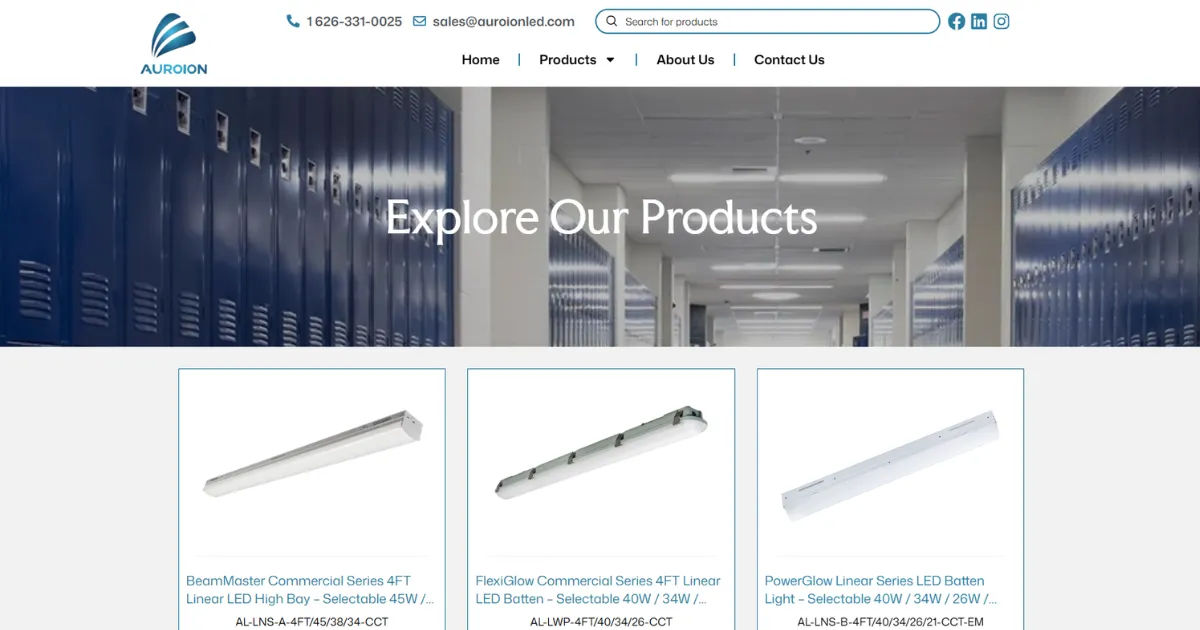
Most buildings need three or four fixture families. Trying to cover everything with one is how you end up with glare in the offices and shadows in the stockroom.
The Four Questions That Decide the Fixture
Before looking at a single product, answer these for each area:
- How high is the ceiling? Under 12 feet, 12-20 feet, or above 20 feet. This alone eliminates most of the catalogue.
- What’s in the air? Nothing, dust, moisture, chemicals, or grease. Anything beyond “nothing” pushes you toward sealed housings.
- What’s the task? Reading, moving, inspecting, or just circulating. Task determines light level and colour rendering.
- Who sees the fixture? Customers, staff, or nobody. This is the only question where appearance matters.
Low Ceilings, Clean Air, People Present
Offices, retail floors, waiting areas, corridors. Recessed troffers and linear strip fixtures dominate here, and the specification variable that matters most is glare.
Look for a UGR figure below 19 for office spaces. Bare-diode fixtures with clear lenses are cheaper and produce the kind of glare that generates headaches and complaints — the false economy shows up as a request to retrofit diffusers 18 months later. Frosted or microprismatic lenses cost slightly more and solve it at source.
Colour temperature: 3500K-4000K. Colour rendering: CRI 80+ generally, 90+ in retail where merchandise colour matters.
Low Ceilings, Contaminated Air
Kitchens, wash bays, cold storage, food prep, parking structures, mechanical rooms. This is where vapour tight fixtures belong, and where standard commercial troffers fail fast.
The sealed housing does two jobs: it keeps moisture and dust off the electronics, and it keeps the fixture cleanable. In food environments the second matters as much as the first, because an uncleanable fixture is an audit finding.
Specify IP65 minimum, IP66 where pressure washing happens, polycarbonate body with stainless clips, and NSF listing anywhere food is handled. Check that the gasket is a moulded one-piece design rather than a cut strip joined at the corners — the joint is where water gets in.
High Ceilings
Above 20 feet, commercial fixture lighting becomes high bay. Round UFO fixtures suit open floor areas — showrooms, gymnasiums, big-box retail. Linear high bays suit racked aisles, where the light needs to run along the aisle rather than spread in a circle.
Beam angle is the spec that decides the outcome. A 120° beam from 30 feet spreads light everywhere including places you don’t need it. A 60° beam concentrates it on the floor. In racked warehousing, narrow beams down aisles beat wide beams almost every time.
The Environments People Get Wrong
Parking garages. Look like dry spaces. Aren’t. Vehicle exhaust, road salt in winter, condensation on concrete decks, and washdowns. Vapour tight is the right call, not commercial troffers.
Loading docks. Partly exterior, temperature-swinging, dusty, with forklift traffic. Wet-location listing and IK08 minimum.
Mechanical rooms. Humid, hot near the ceiling, rarely cleaned. Check the Ta rating.
Walk-in coolers. Drivers that won’t start reliably below freezing are common. Confirm the low-temperature rating explicitly.
Auroion LED supplies commercial vapour tight lighting fixtures for wash-down areas and LED high bay lighting fixtures for open commercial spaces, which covers the two areas where generic commercial fixtures most often disappoint.
Frequently Asked Questions
What’s the difference between commercial and industrial fixture lighting?
Commercial fixture lighting prioritises glare control, appearance and colour quality in occupied, climate-controlled spaces. Industrial fixture lighting prioritises sealing, impact resistance and temperature tolerance. Many buildings need both, sometimes in adjacent rooms.
Do I need vapour tight fixtures in a parking garage?
In most cases yes. Parking structures get condensation, exhaust residue, road salt and periodic washdowns, all of which degrade standard commercial fixtures. Vapour tight housings rated IP65 or higher hold their output far longer in that environment.
What UGR rating should I look for in office lighting?
UGR below 19 is the standard target for offices and any space with screen work. Above that, occupants report glare and eye strain. Frosted or microprismatic lenses are the simplest way to hit it without sacrificing efficiency.
Can I use high bay fixtures on a 15-foot ceiling?
You can, but you’ll usually get better uniformity from linear strip or vapour tight fixtures at that height. High bays are designed for throw distance; used too low they create bright pools with dim gaps between them.